
Montgomery County Court Records After a Jail Arrest
After a person is arrested in Montgomery County and booked at the Montgomery County Jail, the jail record and the court record serve different purposes. The sheriff's detention staff handle receiving, computer book-in, fingerprinting, photographing, searching, change-out, housing assignment, and release processing. The court record begins when a prosecutor files the charge in the Arkansas court system. Montgomery County is part of the Eighteenth West Judicial Circuit, and the Circuit Clerk route identified by the Arkansas Judiciary is Regina Powell at 105 Highway 270 E. #10, Mount Ida, AR 71957, phone 870-867-3521.
The booking side is useful for custody status, release questions, body attachment holds, and whether someone appears on the current or released jail roster. For those details, use jail inmate records. Booking photos are a separate intake-photo issue, handled in jail mugshots. Court records after a jail arrest are the filed charges and case events: complaint or information, court dates, motions, amended charges, bond orders, plea, dismissal, nolle prosequi, sentence, or other disposition.
The official Arkansas Judiciary CourtConnect entry point is the statewide public case-search route referenced by the Montgomery County Sheriff's Office warrants page. Use that route once a case has reached the court filing stage.
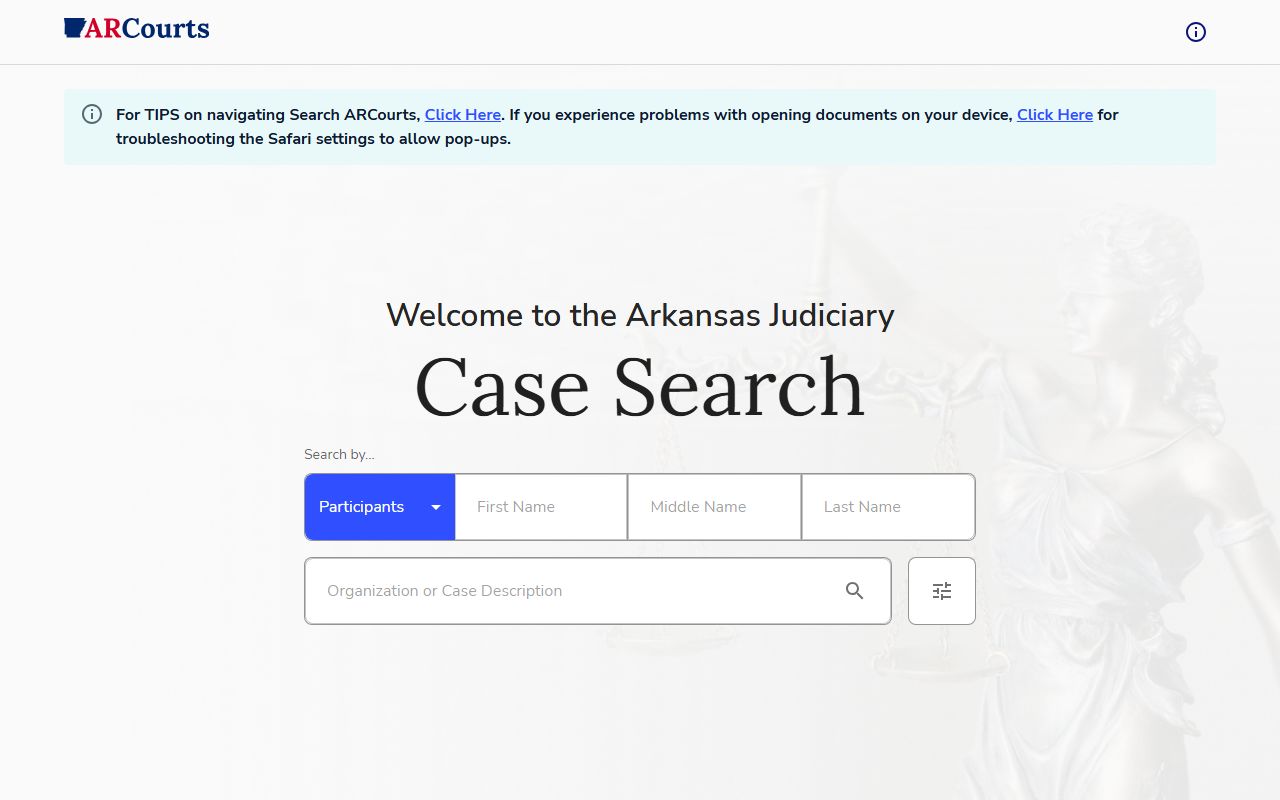
CourtConnect is the right place to look for the court record, while the Montgomery County sheriff roster remains the custody-side source for a recent jail booking.
How to Find Montgomery County Court Records After an Arrest
Start with the timing of the case. A new arrest may appear first as a jail custody entry, if the roster has a public entry at all. Formal court records after an arrest appear after the prosecutor files charges or the citation/ticket matter reaches the court system. The CourtConnect / OPAD page is the official Arkansas Judiciary route for public case lookup, but the research did not confirm exact live field labels because browser protection limited command-line inspection. Use the defendant's legal name, case number, citation number, or other exact identifier when available.
- Open Arkansas Judiciary CourtConnect / OPAD, the case-search route linked from the sheriff's warrant guidance.
- Search by defendant name first; if a case number, citation number, or ticket number is known, use it to narrow results.
- Open the matching case and review the charge list, court level, filing date, hearing history, and disposition fields that are available to the public.
- Compare each charge with the booking or citation information. Booking charges can be amended, reduced, added, dismissed, or replaced by the prosecutor's formal filing.
If the case is not visible online, contact the Montgomery County Circuit Clerk, Regina Powell, at 870-867-3521 or use the clerk address at 105 Highway 270 E. #10, Mount Ida, AR 71957. District Court ticket and time-pay matters follow a different route: the sheriff's payment page points users to pay.courts.arkansas.gov, where a ticket number or time-pay account number is needed. District Court clerk questions go to 870-867-2221, Monday through Friday from 8:00 a.m. to 4:30 p.m., with the office closed for lunch from 12:00 to 1:00 p.m.
The Arkansas Judiciary's circuit clerks directory identifies Montgomery County's circuit-clerk contact and the Eighteenth West Judicial Circuit.
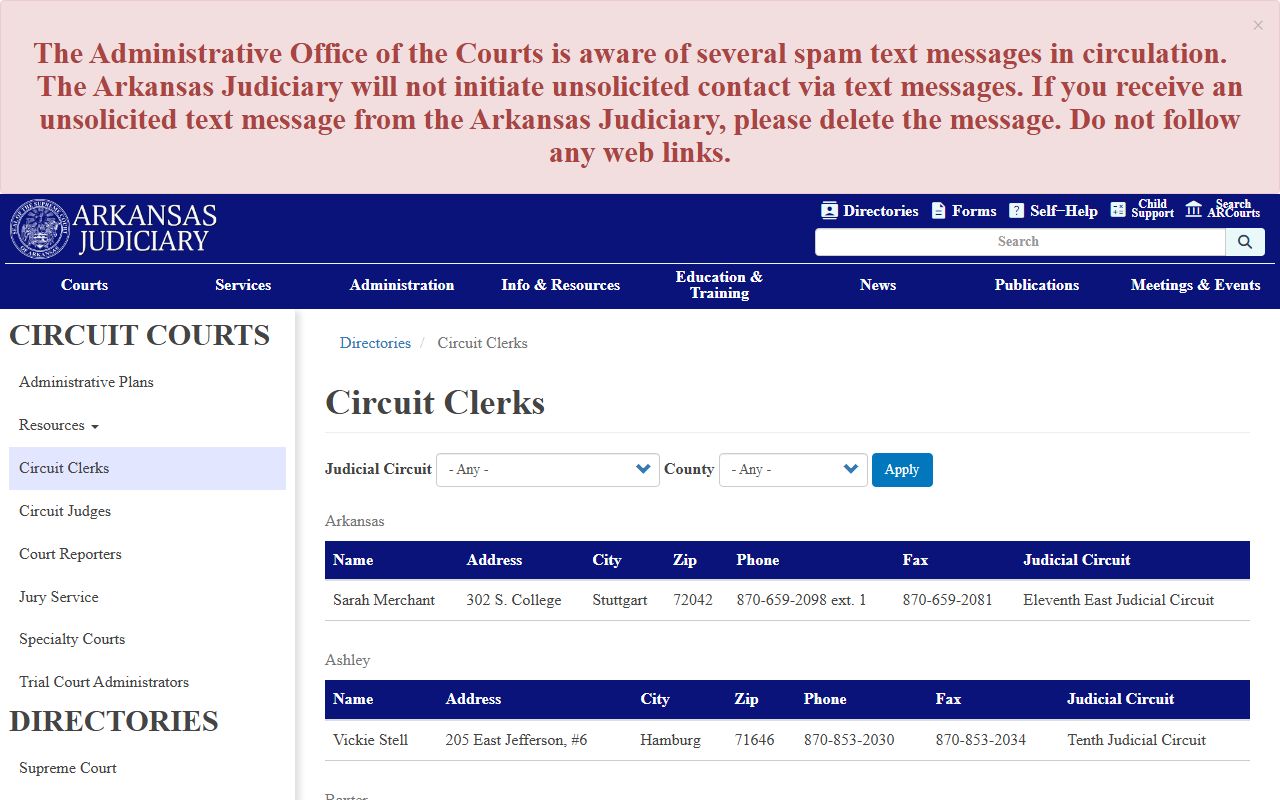
That clerk contact is the local fallback when a Montgomery County court record after an arrest is older, not online, or needs file-level confirmation.
How Charges Get Filed After an Arrest: Complaint, Information, and Indictment
After the arrest and jail booking, the court charge record starts with a charging document. In Arkansas criminal practice, the prosecutor may proceed by complaint or information, and serious matters may also involve indictment. The exact document depends on the case type and court path. The practical point for Montgomery County searches is that a jail roster charge is not the final court record. The prosecutor's filing controls the court case, and later court action can change the status or wording of the charge.
| Complaint | Information | Indictment | |
|---|---|---|---|
| Filed By | Officer or prosecutor, depending on the matter | Prosecutor | Grand jury |
| Common For | Citations, misdemeanors, and initial criminal filings | Many felony prosecutions | Serious felony matters where a grand jury is used |
| Starts | The court case or charge track | The prosecutor's formal court charge | The court case based on grand-jury accusation |
Charge Status and What It Means
Court records after an arrest should be read as a timeline, not as one fixed label. A charge may be pending at first, then amended, reduced, dismissed, or resolved by plea or verdict. The Montgomery County roster can show a custody basis, but the court case shows what the prosecutor filed and what the judge later ordered. If a person was booked on one offense and later appears in CourtConnect under a different charge level or statute, that does not automatically mean either record is wrong; it may show the normal prosecution path.
| Status | What It Means |
|---|---|
| Pending | The charge is still open and has not reached final disposition. Future hearings, motions, plea negotiations, or trial settings may still be listed. |
| Amended / Reduced | The prosecutor or court changed the charge wording, level, count, or statutory basis. Read the docket and final disposition before treating the original arrest charge as current. |
| Dismissed | The court record shows that the charge was ended without a conviction on that count, although other counts in the same case may remain active or resolved differently. |
| Nolle Prosequi | The prosecutor declined to continue prosecution on that charge. Arkansas sealing law may provide a later record-sealing path for eligible nolle prosequi matters. |
Bond and Release After an Arrest
The Montgomery County Sheriff's Office FAQ explains that bond and bail are often used interchangeably and that the purpose is to help ensure the arrested person appears in court. If the arrest is based on a warrant, the warrant generally lists the bond amount. If the arrest is without a warrant, the sheriff FAQ says bond is set by Arkansas Code. Release from the Montgomery County Jail does not close the court record; it shifts the person into a schedule of court appearances and bond conditions.
| Bond Type | How It Works |
|---|---|
| Cash Bond | The full bond amount is posted in cash by the person or someone acting for the person. The money is held by the sheriff or court pending the criminal case disposition. |
| Surety Bond | A licensed bail bonding company secures release. The company's fee is non-refundable and is not applied to fines, costs, or restitution. |
| PR / Own Recognizance | The court allows release based on a promise to appear. The sheriff FAQ says this is rarely authorized except for very minor offenses. |
| No-Bond Hold | Payment alone will not release the person until the court or holding agency clears the hold. Body attachments may require a judge appearance unless the order allows release by a stated cash amount. |
The sheriff's FAQ page gives the local bond definitions, FOIA exceptions, and body attachment explanation used for Montgomery County jail and court-record context.
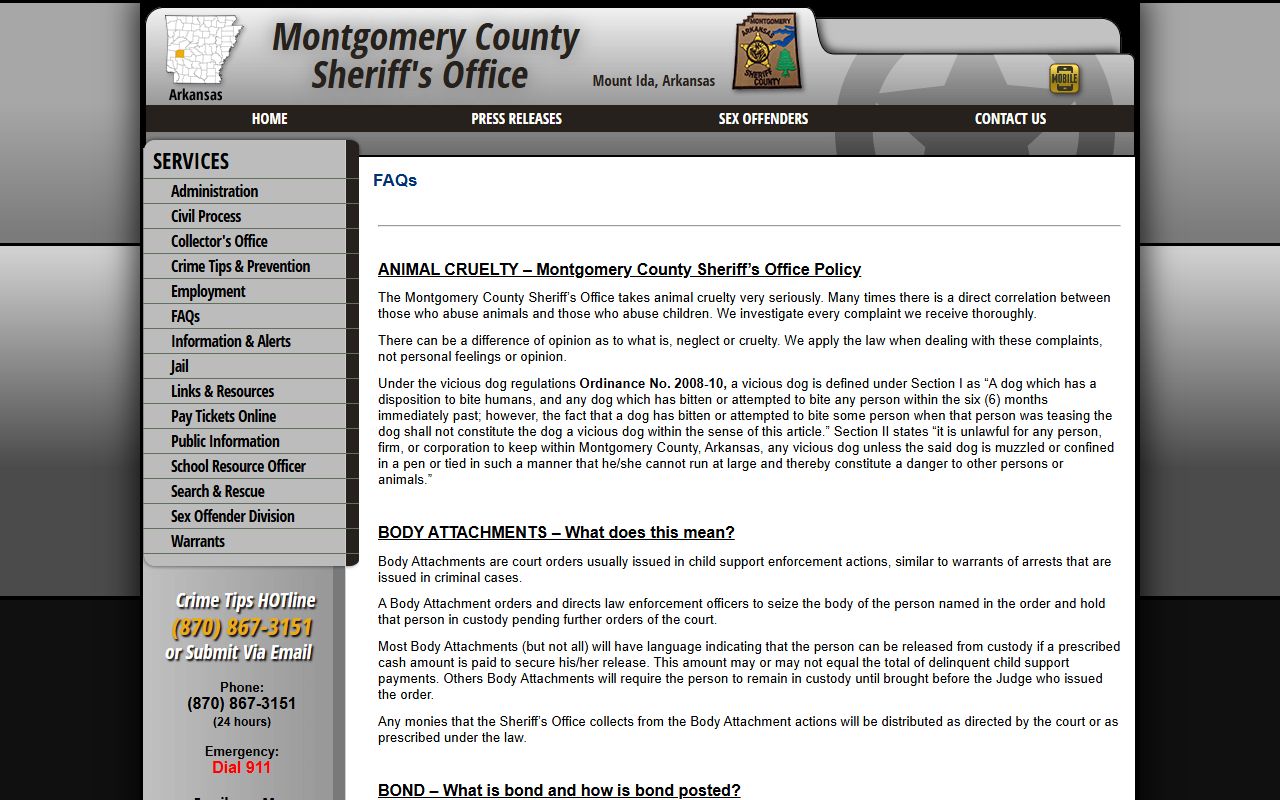
Because the FAQ also lists public-record exceptions, it is useful for both bond questions and limits on what the sheriff can release from arrest or booking files.
Warrants That Lead to an Arrest
The official Montgomery County warrants page does not provide a searchable sheriff warrant list. It states that the sheriff's office does not give out warrant information by phone, and it points users to online Arkansas court records at AOC CourtConnect. That matters for court records after an arrest because a warrant can cause the booking, while the court file explains the underlying case or order. Do not rely on the jail roster as a warrant search; the roster only helps after a person has been booked or recently released.
Body attachments also appear in the sheriff FAQ and can look warrant-like to families. A body attachment is usually issued in child-support enforcement or similar court matters and directs law enforcement to seize and hold the person pending court order. Some allow release by paying a specified cash amount; others require the person to remain in custody until brought before the judge.
The Montgomery County Sheriff's Office warrants page explains the no-phone-warrant-information rule and directs users toward CourtConnect.
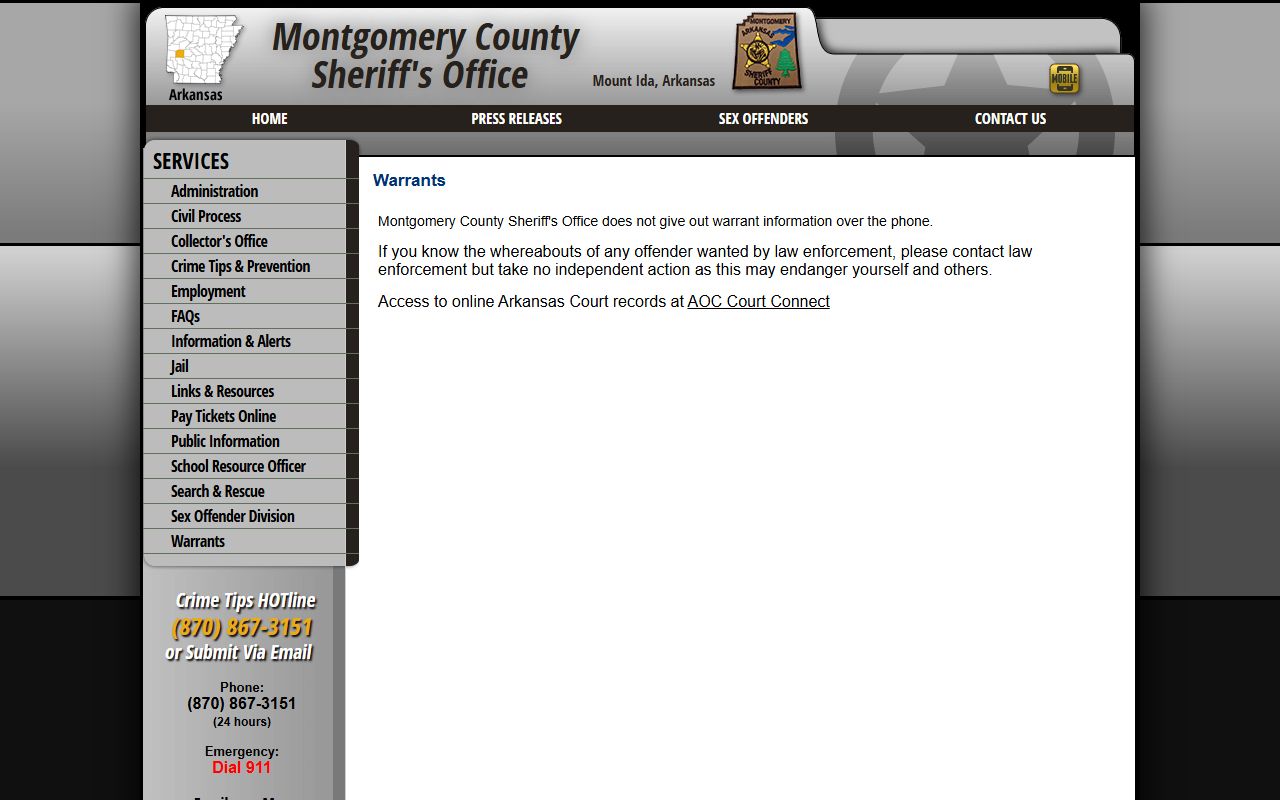
For safety and accuracy, use the court route for warrant-related records and do not confront anyone believed to have an outstanding warrant.
Charges vs. Convictions
An arrest, booking, or filed charge is not a conviction. A charge is an accusation filed or pursued in court. A conviction requires a plea, verdict, or other qualifying court disposition. This distinction is important when reading Montgomery County court records after a jail arrest because early records often show allegations before the court has decided the case.
| Charge | Conviction | |
|---|---|---|
| Stage | Accusation or filed count | Verdict, plea, or final court disposition |
| Burden of Proof | Probable cause or charging standard | Beyond a reasonable doubt for trial conviction, or plea accepted by the court |
| Public Record | Often public unless restricted, sealed, juvenile, or otherwise exempt | Often public unless sealed, restricted, or otherwise exempt |
Sealed vs. Expunged Arrest Records
Arkansas law provides record-sealing routes for some arrest and criminal-case outcomes. The research identifies Ark. Code Ann. 16-90-1409 for sealing arrest records when charges have not been filed by the prosecutor within one year of arrest, and Ark. Code Ann. 16-90-1410 for nolle prosequi, dismissed cases, acquittals, or prosecutor decisions not to file. The sheriff FAQ also lists sealed or expunged records as an exception to public disclosure.
| Sealed | Expunged | |
|---|---|---|
| Visibility | Restricted from ordinary public access by court order | Often used generally to describe a record treated as removed from public access; Arkansas materials commonly route eligible cases through sealing statutes |
| Law Enforcement | May remain available for limited criminal-justice purposes under law | Access depends on the exact court order and statute; do not assume every agency file disappears automatically |
| Eligibility | Can include eligible no-file, dismissal, acquittal, or nolle prosequi situations under Arkansas law | Use the court's Arkansas sealing process and the specific order; eligibility is not decided by the jail roster or a private website |
Background Check Considerations
The Montgomery County Sheriff's Office FAQ says the office may provide information available under Arkansas FOIA, but it cannot provide criminal-history or background information from ACIC or NCIC databases. For statewide criminal-history checks, use Arkansas State Police / ACIC routes instead of expecting the county jail or Circuit Clerk to produce a complete background report. A court case lookup is a public-record search, not an FCRA-compliant employment, tenant, credit, or insurance screening report.
The Arkansas DPS / ACIC criminal-history forms page is the state route for criminal-history review and related forms.
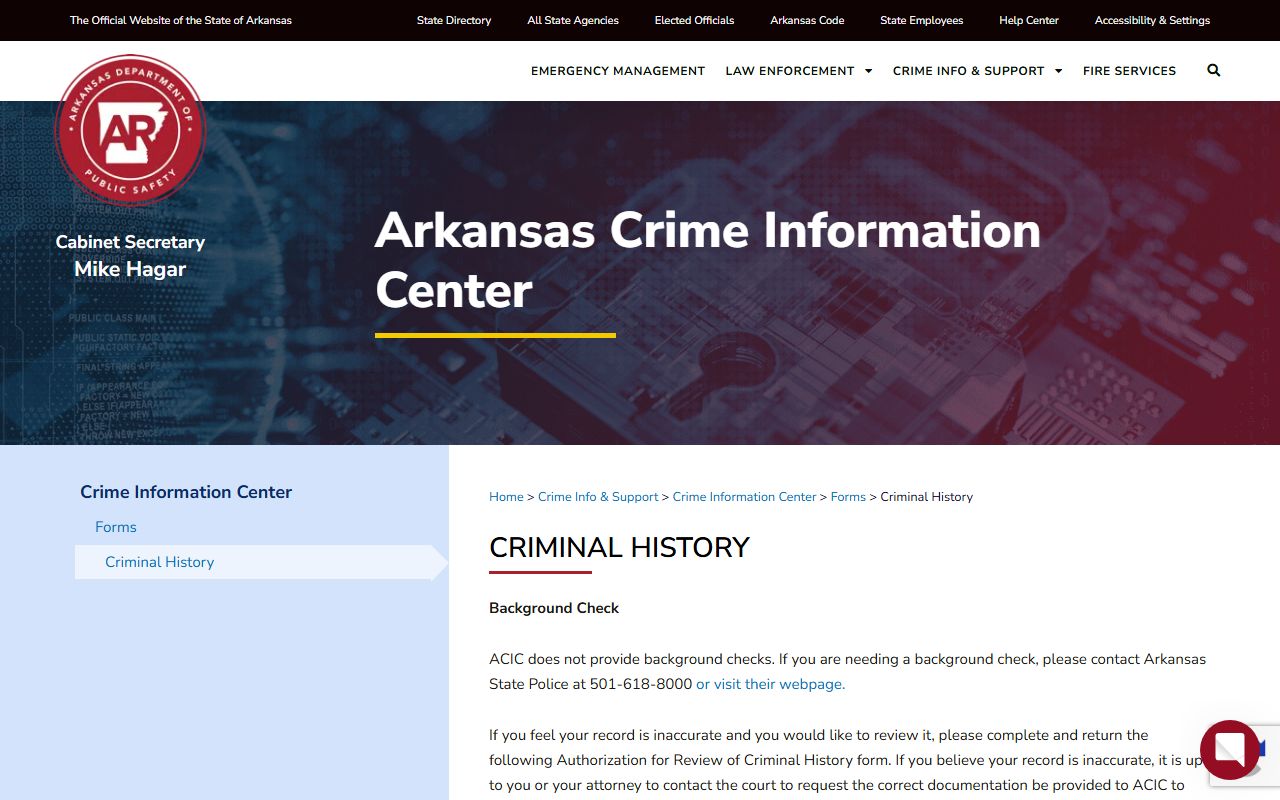
Use the state criminal-history route when the question is broader than one Montgomery County court file or booking event.
Important: This site is not a consumer reporting agency and cannot be used for FCRA-covered screening decisions.
Restricted Court Records After an Arrest in Montgomery County
Arkansas FOIA and local sheriff guidance do not make every arrest-related record public. The sheriff FAQ lists active or open criminal investigations, certain personnel records, sealed or expunged records, and juvenile records as exceptions. Court files may also be restricted by sealing order, juvenile confidentiality, or a specific court rule. If CourtConnect does not show a Montgomery County court record after an arrest, the reason may be timing, no filed case yet, spelling, a different court level, an older file, or a legal restriction.
District Court and Circuit Court payment channels are not a substitute for reading the case file, but they are useful when a person has a ticket, time-pay account, fine, or balance question. The sheriff's Pay Tickets Online page lists District Court online payments through the Arkansas court payment portal and Circuit Court credit-card payments through MyFinePayment.
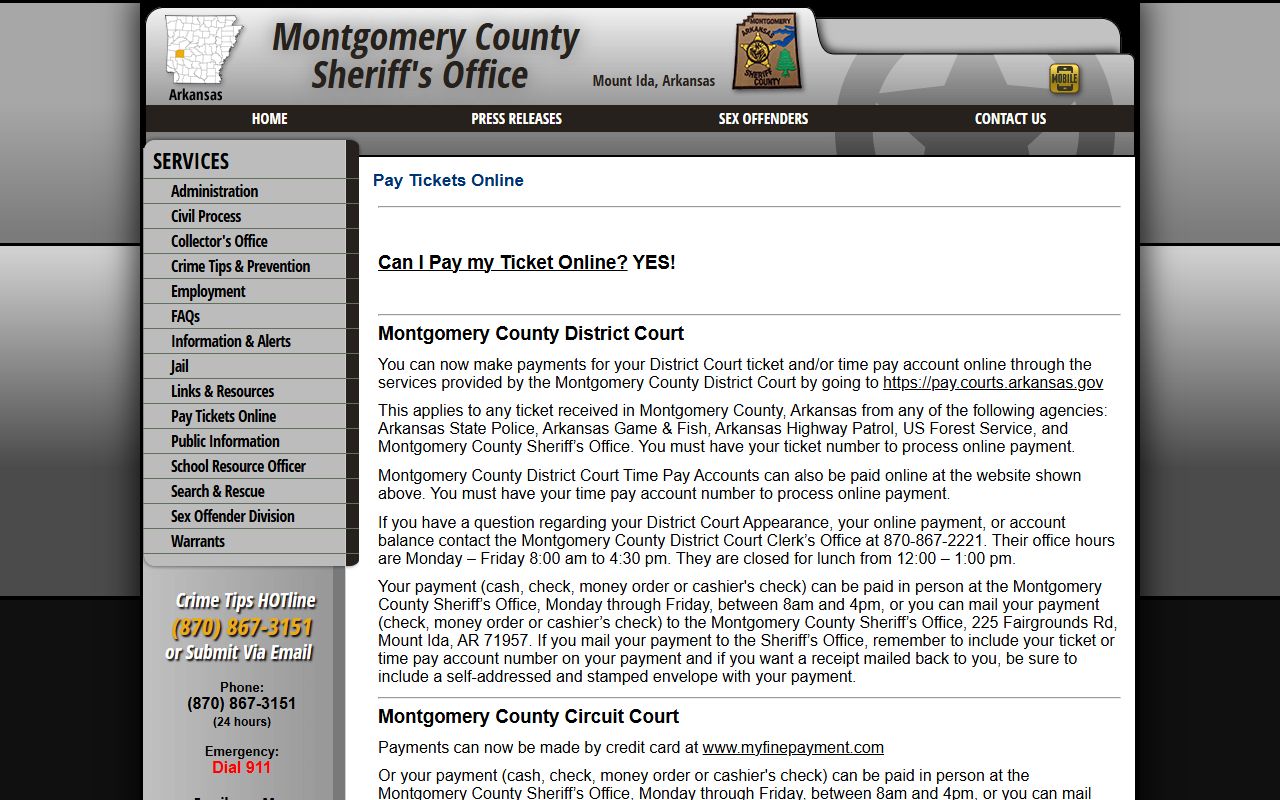
Appearance questions for Circuit Court go to the Prosecuting Attorney's Office at 870-867-4145, while Circuit Court balance questions go to the Sheriff's Office at 870-867-3155 during administrative hours.